
Other Items
Personal Information
- Professor, NIU Physics Department since 1987
- Research Scientist, SUNY-Stony Brook 1981-1986
- Ph.D., University of Wisconsin 1980
- B.A., Southern Illinois University 1975
- born in Chicago, grew up in Wisconsin, lived in New York, but always a Bears and Cubs fan
Photos
Research Interests and Publications
I am a member of the Mu2E experiment at Fermilab after spending over 30 years on Fermilab's D0 experiment.
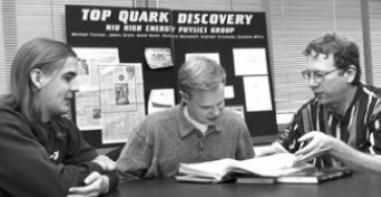
I have been involved in experimental particle physics since 1976. I did thesis work on a number of Fermilab neutral kaon experiments including production of pi-mu atoms (my thesis topic), KS regeneration, and KL scattering cross section measurements with a group from Wisconsin, Stanford and Chicago, under the leadership of Sam Aronson, Mel Schwartz, and Bruce Winstein. After receiving my Ph.D., I did my postdoc work at Stony Brook under Mike Marx and Paul Grannis. My initial effort was on a Brookhaven neutrino experiment which investigated neutrino oscillations, and weak neutral currents using the nu p->nu p and nu e->nu e channels. In 1982, I also began working on a new experiment at the Fermilab collider, LAPDOG, which evolved into D0. D0 is a large, over 5000 ton, general purpose experiment designed to be sensitive to all physics within reach of the 2 trillion electron Volt energy available at Fermilab's collider. Over 500 physicists from 90 institutions and 18 countries are members of this collaboration. In 1995, we, along with another Fermilab experiment CDF, discovered the top quark, up to now the heaviest observed of the fundamental particles which make up our universe. Tevatron operations at Fermilab ended in 2011 and D0 is currently completing its analysis of its full data set. In 2012, D0 along with CDF, saw evidence of the Higgs boson in the channels associated with the Z or W, and experiments at CERN then discovered it.
My primary responsibilities on D0 have been the muon system design, construction, and operation, and on exploiting muons for a variety of physics processes, especially using them to help trigger and tag b-decays. I have been involved in measurements of b-quark production and searches for new phenomena containing b-quarks and missing energy. This has included Higgs decay, third generation leptoquarks and bottom squarks. I helped design both the Run I and Run II upgraded muon detectors and constructed aspects of the PDT and scintillator systems, and was the coordinator of the muon identification group with primary responsibility for muon reconstruction from 1985 to 1997 and, for Run II, from 2000 to 2001 and again from 2008-2012. I was also a B-physics coordinator from 1990-1994 and helped formulate some of the ideas now being exploited in Run II in that area including the intital (and very preliminary) studies of using dimuon charge asymmetries.
I am currently a member of the Mu2E experiment at Fermilab which will search for the conversion of a muon to an electron in a nuclear field. My activity of Mu2E is primarily simulating the signal and backgrounds, looking at shielding and muon bealine optimizations, and contributing to the design and construction of the extinction monitor system. I was co-leader of the Neutron Working Group from 2012-2018 and co-leader of the Simulation Group from 2018-2019.
In 1987 I co-founded the NIU experimental high energy physics group. This group has been supported by grants from the Department of Energy, the Department of Education, the National Science Foundation, the State of Illinois, and directly from Fermilab and Argonne. Over 200 NIU undergraduate and graduate students have worked with me, doing a variety of different projects such as building detectors, testing electronics, and analyzing data with 22 receiving MS or Ph.D. degrees under my supervision.